
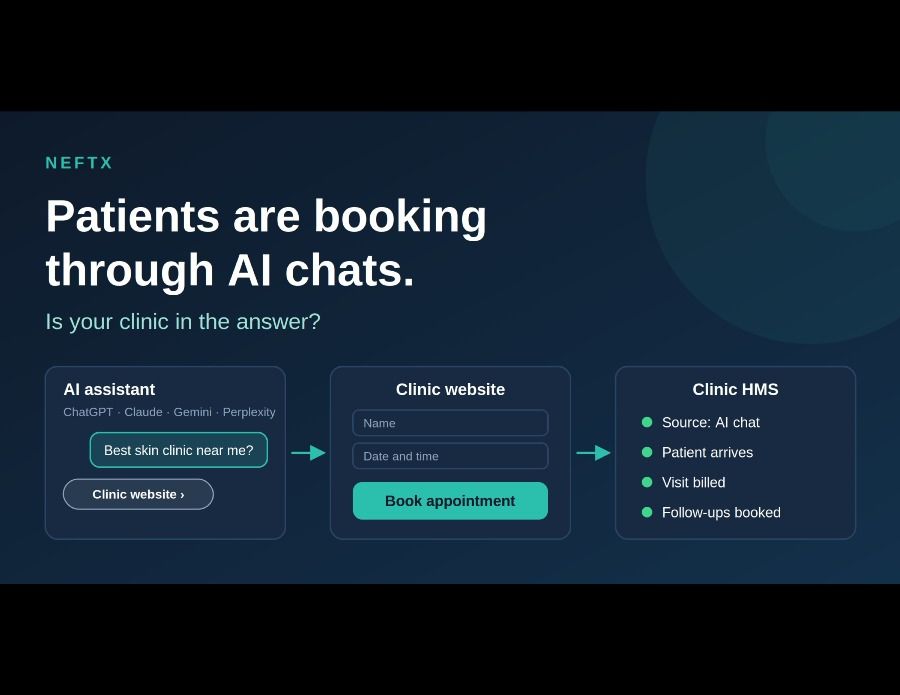
For years, getting found online meant one thing: rank on Google. At Neftx, we've been saying for a while that this won't hold. Patients are starting to ask AI assistants like ChatGPT, Claude, Gemini and Perplexity which clinic to visit, and they book straight from the answer.
That's no longer a prediction. It's showing up in our booking data.
What we saw
Clinic websites built on our platform are being cited by ChatGPT, and patients are booking appointments from those answers.
We found bookings tagged with ChatGPT as their source across four different clinics. ChatGPT adds that tag only when it links to a website in one of its answers. Patients use Claude, Gemini and Perplexity the same way, but those visits usually arrive without a label, so what we can see is likely only part of the picture. Every one of the tagged patients asked an AI a question, got pointed to a clinic built on our platform, and booked.
The numbers are still small, but they are rising. The first booking came in August 2025. Two arrived in the last week alone. And the patients showed up for their appointments. Someone who books on an AI's recommendation arrives with real intent.
Why we could see it and others can't
We spotted this because the clinic website and the hospital management system are one connected product.
In most clinics, the website is built by one agency, bookings go through a third-party widget, and billing lives in separate software. The trail breaks at every hand-off. A patient who came from an AI assistant becomes just another name at the front desk.
On our platform, the trail stays intact from start to finish:
- A patient asks ChatGPT, Claude, Gemini or Perplexity for a specialist and gets a clinic website built on our platform in the answer.
- They book on that website, and the booking carries its source into the appointment record.
- The appointment, the visit and the billing all live in the same system.
That means a clinic can see not just that a patient came from an AI assistant, but that they showed up and what they went on to spend. That's the power of a website and an HMS built to work as one.
SEO is still needed. GEO is the new half.
SEO gets your clinic onto Google's list of links. GEO, or generative engine optimisation, gets your clinic into the answer an AI gives.
The difference matters. Google shows ten links and lets the patient choose. An AI assistant usually names two or three clinics and explains why. If you're not among them, the patient never sees you.
AI assistants recommend what they can read, understand and verify. They look for clear facts about who you are, what you treat, who your doctors are, where you are and what it costs. They cross-check that against other listings and reviews. A beautiful website that an AI can't read, or can't trust, doesn't make the cut.
This doesn't replace SEO. Much of the groundwork is shared, and Google itself now shows AI-written answers above its links. But clinics that only think about Google rankings are preparing for half of how patients will search.
What clinics should do now
Five steps make a clinic easier for AI assistants to find and recommend:
- Make your website readable by machines. Pages should show real text to crawlers, not content that only appears after scripts run. Don't block AI crawlers from reading your site.
- State the facts plainly. Specialties, treatments, doctor names and qualifications, address, hours and fees should all be on the page in clear words, with structured data behind them.
- Keep your listings consistent. Google Business Profile, Bing Places, Practo and Justdial should carry the same name, address and phone number. AI tools check one source against another.
- Answer the questions patients actually ask. "How many sessions does laser hair reduction take?" "What does a skin consultation cost in Hyderabad?" Clear answers written by a named doctor get cited.
- Earn reviews. Genuine patient reviews are one of the strongest signals an AI uses to decide whom to trust.
Clinics should keep their content educational and factual, in line with NMC guidance on how doctors may present themselves to the public.
The clinics that are ready will win
Patients are already booking through AI chats, and this is only the beginning. The clinics that get recommended will be the ones an AI can clearly read, understand and trust.
We build clinic websites with this in mind, connected directly to the HMS that runs the clinic. So when an AI sends a patient your way, you'll know it, and you'll know what that patient is worth.
If you want your clinic to be in the answer, not just on the list, let's talk.